
AI Video Translators for E-Learning Content
Table of Contents
- The Need for Multilingual Learning
- How AI Video Translation Works
- Benefits for the E-Learning Industry
- Practical Applications
- Integration with Modern E-Learning Platforms
- The Broader Impact on Global Education
- FAQs
The e-learning industry is experiencing explosive growth worldwide. Universities, training organizations, and individual educators are increasingly relying on video-based courses to deliver instruction. However, the global nature of online learning brings one critical challenge: language. Most educational videos are produced in a single language—often English—while learners come from every linguistic background.
AI video translators are revolutionizing this space by breaking down the language barrier. They enable rapid, cost-effective translation of educational videos into multiple languages, allowing learners everywhere to access the same high-quality content in their native tongue. This technology is not just a convenience—it is a fundamental transformation in how knowledge is shared, localized, and experienced globally.
The Need for Multilingual Learning
Digital education has made learning borderless. A lecture recorded in New York can be watched by a student in Nairobi or New Delhi within seconds. Yet, understanding complex subjects requires more than just access—it requires comprehension. Many learners struggle to fully grasp course material when it’s not in their native language.
Traditional solutions—manual translation, subtitling, and dubbing—come with significant limitations. Subtitles are often distracting for visual learners. Manual dubbing, meanwhile, requires professional translators and voice actors, which increases both costs and production time. For large-scale educational projects or corporate training programs that require frequent content updates, such methods are impractical.
AI video translators solve this by automating the entire process. Within hours, a course can be transcribed, translated, and voiced in multiple languages with remarkable accuracy and fluency.
How AI Video Translation Works
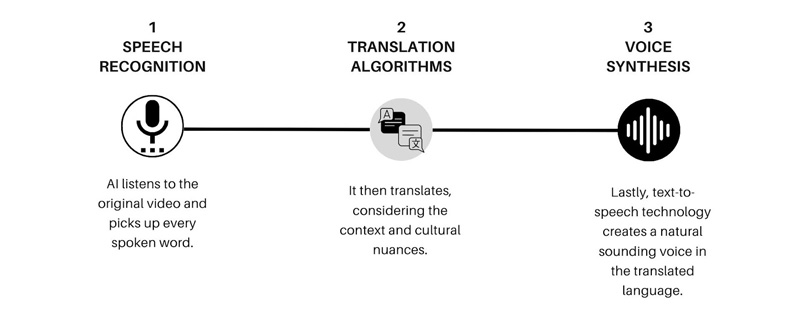
Modern AI video translators are powered by several core technologies working in concert to produce natural, synchronized multilingual content.
1. Speech Recognition (ASR)
Automatic Speech Recognition converts spoken dialogue in a video into text. Advanced ASR systems use deep neural networks trained on massive multilingual datasets. They can recognize different accents, handle technical vocabulary, and maintain sentence-level accuracy even with background noise or multiple speakers.
For e-learning, this is particularly valuable—lecturers often use domain-specific terminology that generic systems struggle with. Cutting-edge ASR models can adapt to these contexts, ensuring that every technical term, formula, or acronym is correctly captured.
2. Neural Machine Translation (NMT)
Once the speech is transcribed, Neural Machine Translation systems convert it into the target language. NMT models, based on Transformer architectures, understand the semantic and contextual meaning of sentences rather than translating word by word. This produces fluent, human-like translations that preserve tone, intent, and nuance.
For e-learning, this ensures that explanations, metaphors, and examples retain their pedagogical impact in the translated language—an essential feature when teaching complex or abstract concepts.
3. Voice Synthesis and Voice Cloning
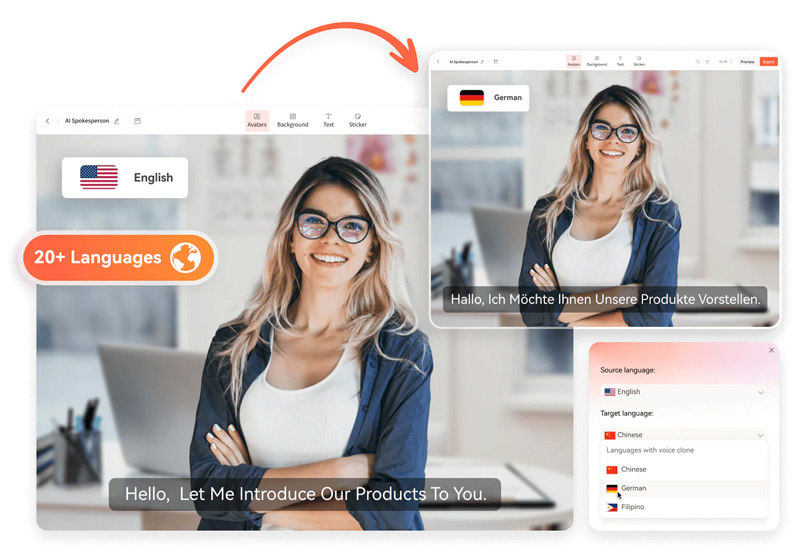
After translation, Text-to-Speech (TTS) technology generates audio in the target language. Modern TTS systems can create realistic, expressive voices that sound natural rather than robotic. With voice cloning, the AI can even reproduce the instructor’s original tone, pitch, and rhythm in another language.
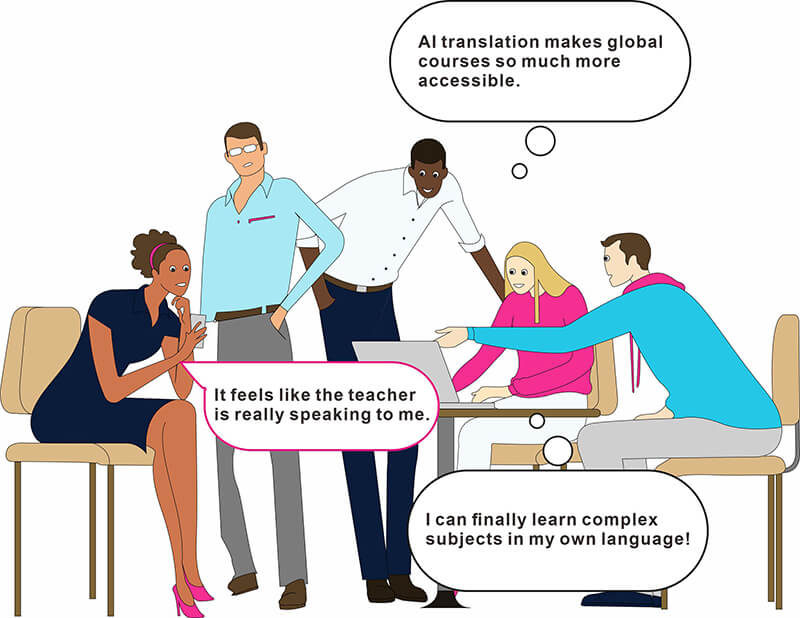
This creates an authentic learning experience: the same teacher’s voice, the same emotion and delivery style, but in a new language. Students feel as though the instructor is speaking directly to them in their native tongue.
4. Video Synchronization and Subtitling
The final step aligns the generated audio or subtitles with the video’s timing. Sophisticated synchronization algorithms ensure that speech pacing, visual cues, and lip movement remain natural. Subtitles are automatically formatted and timed, maintaining readability and accessibility.
Benefits for the E-Learning Industry
Rapid Localization
AI video translators allow educational institutions and content creators to localize their videos at unprecedented speed. A course that once took weeks to translate and dub can now be made multilingual overnight.
This agility enables global simultaneous launches, helping universities and companies reach broader audiences. For example, a coding course recorded in English can be instantly available in Spanish, Mandarin, or Arabic, making it accessible to millions more learners.
Cost Efficiency
The automation of transcription, translation, and voice generation reduces production costs dramatically. Organizations no longer need separate teams of translators, editors, and voice actors for each language version.
For large e-learning providers managing hundreds of hours of video content, this cost reduction is transformative. It allows budgets to be redirected toward course design, interactivity, and learner engagement rather than production overhead.
Consistent Quality
Manual translation processes often suffer from inconsistency across courses or modules, especially when handled by different translators. AI systems maintain a consistent tone, terminology, and formatting across all videos.
Some platforms even allow instructors to upload glossaries or domain-specific dictionaries, ensuring technical accuracy and brand alignment across multilingual versions.
Improved Learning Experience
AI-generated voiceovers provide a seamless experience compared to subtitles. Learners can focus on visuals, gestures, and demonstrations without splitting attention between reading and watching.
Moreover, hearing the same instructor’s familiar voice—even in a different language—builds trust and engagement. It reinforces a sense of connection and continuity, especially in long-term courses or certification programs.
Accessibility and Inclusion
AI video translation enhances accessibility for learners with hearing or reading difficulties by combining high-quality voice synthesis with optional subtitles. It also democratizes access to education by bringing content to regions where English proficiency is limited.
This is particularly impactful for K-12 programs, vocational training, and social learning initiatives in developing countries. AI-powered translation ensures that language is no longer a barrier to opportunity.
1. Universities and Online Course Providers
Higher education institutions can deploy AI video translators to make entire curricula multilingual. A single recorded lecture can serve global campuses, exchange programs, or international partnerships. Platforms like Coursera, edX, and Udemy are already experimenting with AI-driven translation pipelines to expand their reach.
2. Corporate Training and Compliance Programs
Global companies use video-based training to maintain consistent skill levels across teams in different countries. AI video translation allows instant adaptation of safety training, onboarding programs, or compliance modules without duplicating production costs.
This ensures that employees in Tokyo, São Paulo, and Paris receive identical content, customized to their native languages.
3. Educational NGOs and Public Projects
Nonprofit organizations focused on education can use AI video translation to distribute critical learning materials to underserved communities. Subjects like digital literacy, healthcare education, or environmental awareness can be quickly localized for different regions, ensuring inclusivity and reach.
4. Independent Educators and Content Creators
Individual teachers, YouTubers, and online coaches can scale their audiences globally. Instead of producing separate videos for each language, creators can upload one version and instantly generate multiple localized editions.
This opens new revenue streams and helps build international communities around niche subjects.
Integration with Modern E-Learning Platforms
AI video translators can be seamlessly integrated into most Learning Management Systems (LMS) or content management platforms. Through APIs and automation tools, translated videos can be automatically uploaded, categorized, and tagged with metadata for different languages.
Learners can select their preferred language version directly from the platform interface. Some systems even allow dynamic switching during playback—changing from one language to another in real time without reloading the video.
In addition, the same translation engines can generate multilingual transcripts, quizzes, and summaries, ensuring every aspect of the learning journey remains coherent across languages.
The Broader Impact on Global Education
AI video translators are not just tools for convenience; they are catalysts for educational equality. By drastically lowering the barriers to multilingual content creation, they enable knowledge to flow freely across borders.
Educators can reach previously underserved audiences. Learners can engage with world-class content without the obstacle of language proficiency. Companies can train global workforces with unified material. The result is a more connected, informed, and empowered global learning ecosystem.
AI video translators can be fine-tuned with domain-specific glossaries or custom vocabulary databases to ensure accurate handling of specialized terminology. For instance, a medical course can include Latin terms or pharmaceutical names, while a programming tutorial might integrate coding syntax and technical jargon. This customization ensures consistency across translations and prevents the loss of technical meaning that often occurs with generic machine translation.
AI-generated subtitles focus on visual text display synchronized with spoken content, while AI voice translation involves converting the translated text into spoken audio—often using voice cloning or TTS (Text-to-Speech) technologies. For learners who prefer auditory learning or courses that rely on tone, emotion, and rhythm (e.g., storytelling, coaching), AI voice translation provides a far more immersive and natural experience than subtitles alone.
Yes, advanced AI systems now support real-time or near real-time translation. In live e-learning environments, AI can capture the instructor’s speech, instantly transcribe and translate it, and deliver synchronized multilingual captions or synthesized audio. This capability is especially valuable for international workshops, global webinars, and virtual classrooms, allowing participants to engage in their preferred language without delay.
Quality assurance is achieved through a hybrid approach: AI automation combined with human review. Many e-learning platforms allow educators to review, edit, or approve translated transcripts before publishing. Additionally, AI models can be trained using the educator’s previous corrections, continually improving accuracy over time. This feedback loop ensures a balance between scalability and precision.
Institutions typically measure success through a combination of learner engagement, comprehension outcomes, and content accessibility metrics. Quantitative indicators include watch time, dropout rates, quiz performance in multilingual groups, and feedback surveys. Qualitative feedback—such as perceived clarity, cultural relevance, and emotional tone—also provides valuable insights for refining translation models and optimizing future multilingual learning materials.